Pages

Showing posts with label felting. Show all posts

Saturday, 29 April 2017

A few smallish things

I haven't got any newly completed garments at the moment, but I have some other things that I haven't blogged about. A few days ago I finished this box. 

I started it a couple years ago in bookbinding class, and now I've finally gotten around to covering it and gluing it together. I think I had originally intended it to be a sewing box with a more elaborate interior, but I just wanted to get it off the Unfinished Things pile, so the inside is plain striped quilting cotton. The outside is covered in black cotton twill.
I didn't cut my pieces as accurately as I should have, but the lid fits pretty well.
Not sure what I'll use it for. It still could be a sewing box.
I made this green hat in felt class, shortly before I made my tricorn. I didn't make my pattern big enough so it came out really, really small, and barely fits this foam head.
I think it's still at school, and I don't have any use for it.
I carved a linoleum block a couple days ago! It was a commission for a heart & stroke event.
Speaking of commissions, two people are going to buy these shitty dinosaur prints from me, and I am amazed.
Two humans got me to print these and will pay me real actual money for them.

I posted about the fish I block printed, but I never posted this other block I did for class, so here are some pictures of it.
I did some prints on a piece of paper.
And some on fabric.
I haven't done anything with these 3 bits of cotton yet, but they were fun to print. Though I wish the edges hadn't printed darker than the middle of the block.
It's a half drop repeat, with swirliboops based on the ones I embroidered on my waistcoat.
I will hopefully have some finished sewing things soon!

Sunday, 19 March 2017

Awful Slippers

Update: I was a fool! I am sorry! Please, dear slippers, forgive the title of this post! I love my monster slippers very much now and wear them all the time!

Well, maybe awful is a bit harsh, but these are definitely not my best work and I don't like them much at all. I made them for felting class, and they aren't symmetrical, or evenly dyed.
 One's a bit tighter than the other. I tried to dye them brown, but I must have put too much dye in the pot because they went black.
 I put plasti dip on the bottoms, so they have something resembling a sole, and will wear much better than just plain felt.
I had to embellish them for the assignment, and I thought them too ugly to put much more work into, so I added eyes and a top row of pointy teeth.
The pupil is black wool fabric, and the white bits are wool felt.

If I make any other felted footwear it'll be taller, because I don't like the shape of these.

Tuesday, 14 March 2017

1780's-90's Cocked Hat

I have made a hat!
I like my hat very much.
I was aiming for the general look of the hat in this fashion plate.
Young Officer in a Zebra Coat, calling someone to give an account of his services. Galerie des Modes, 1789. Source.
As far as I can tell, the one in the fashion plate is this shape, with the edge folded up in back being much longer than the front two. (I have some more extant hats in the same style on this pinterest board.)
Military cocked hat, late 18th century. Source.
(The one I made isn't meant to be a military hat, so I hope the trim isn't too similar.)
Mine is wet felted merino fleece, and I made it for a hat assignment in felting class.
One side laid down. I don't know why I couldn't get a clear photo of this.

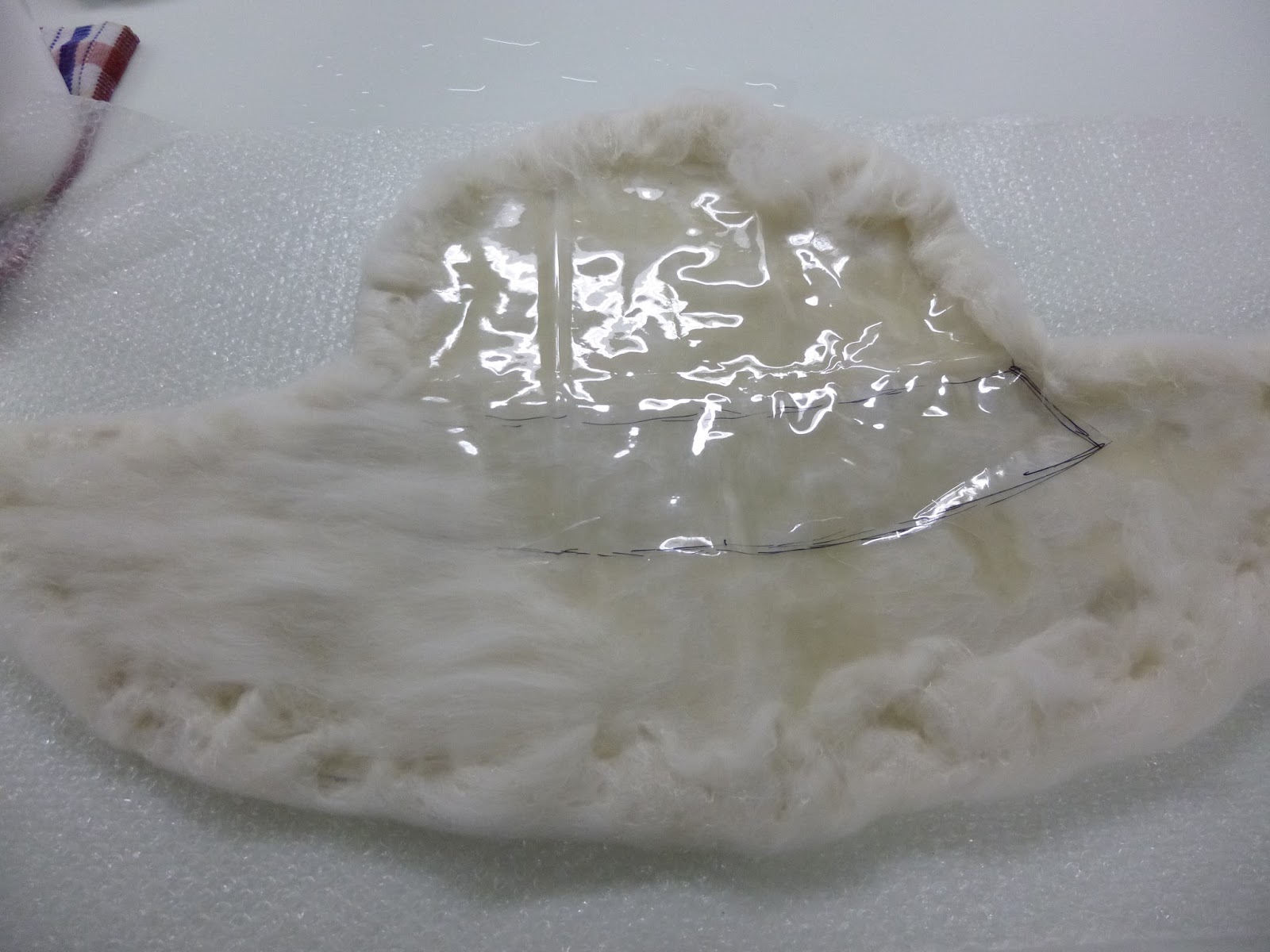
Pattern separating the layers, and the second side partly laid down.
The pattern is quite large (about 2 feet across, I think) to account for shrinkage.

Hat partly felted, with the brim cut open and the pattern removed.
The crown is sitting on an upside down ice cream container here so I can felt the sides more easily.
Once the hat was sufficiently felted I dyed it with acid dye.
Here it is being dyed for the second time, because the first time it didn't come out black enough.
I had failed to remember while I was felting that the tops of all the extant hats are flat, and so I had to do some reshaping. I dampened the hat and pulled it over a coffee can, and managed to mash the domed top down into a nicely flat one. I also had to stretch the band part over a paint can, because it had shrunk in the dye pot and was now slightly too small.
The hat after dyeing and before blocking.
(Can I still call it blocking if it's a large can and not a bock?)
I stiffened the whole hat with watered down fabric stiffener. I'm not sure what the historically accurate method would be, but this worked quite well.
Almost done!
I did it in 3 steps to make sure things would dry in the right place.
(First the crown, then the back, then the front.)
I used fabric stiffener for the trim too. I dyed a piece of white silk twill, and then painted it with slightly thinned stiffener and let it dry. I'd never used fabric stiffener before this project, and I was quite pleased with the results. The silk went crisp and papery.
I pinked the edge, and then snipped out half the zig zags because the pinking was too small.

My box pleats came out a bit wonky and I blame the moisture from my hands.
I pleated it up, folded another strip of the material for the bit that goes on top, and added a mother of  pearl button from my stash. The hat in the fashion plate has what appears to be a diamond shaped steel button, and this was the closest thing I had.


It's done! I finally have a hat!! It still needs a lining, but I can add that later.
It's not perfect, nor entirely symmetrical, but for a first attempt I think it turned out very good and I am proud of it!


All the photos here of me wearing the hat were taken by Denise Richard, who is my felting teacher.
I quite enjoyed making this and I want to make more hats!

Wednesday, 18 September 2013

Liripipe Hood

This is an older project. I made it before I started this blog so I don't have any in-progress pictures of it.
It's a liripipe hood!

Judging from my sketchbooks, I made this sometime around the beginning of August 2012. I had been reading a book on Medieval costume from the school library when I came across a picture of a liripipe hood. I immediately decided that liripipe hoods were awesome and that I needed to make one.

A definition of the word "liripipe" can be found here, some Medieval illustrations of them can be seen here, and an article on hoods and liripipes can be read here.
From what I remember reading in the book they were a man's garment that was popular around the 14th century. They were usually made of wool and the liripipes were separate pieces that were sewn on to the back of the hood. With all the fashionable men trying to outdo each other, the liripipes kept getting longer and longer until they had to be tied into fancy knots to keep them from dragging on the ground.

The pattern is pretty simple so it didn't take much work. I drew the pattern on an old sheet and used that as a mockup. It seemed to fit okay. It is loosely based off of hood #4 in this illustration.
The light spot was caused by a stain on the blanket that blocked some of the dye.
I cut my pieces from a grey wool blanket with blue stripes on the ends. There was just enough room to get all 3 pieces out of it without any of the blue stripes ending up in the garment. I put the pieces, plus a small scrap, into a big pot with forest green acid dye.
My mother teaches dyeing and has a small dye kitchen right outside my room, which is quite useful when something isn't the right colour.
The scraps that I didn't dye.
The colour is mostly even. Despite my constant stirring, there was one place where the wool was at the bottom of the pot for too long and came out much darker than the rest.
I don't really mind.
Oops.
The seam holding the two halves together is whip-stitched with fine linen yarn. I dislike sewing bulky fabrics by machine because you can't match the thickness of the thread to the thickness of the fabric. There is a running stitch going down the middle of both seam allowances to keep them open and flat, and to help hold the lining in place. There is also a running stitch inside the edge of the hood.
The inside of the hood.
The liripipe is made from one piece and is exactly one metre long. It is also whip-stitched. I sewed it up right side out because turned liripipes always look too thick and bubbly and I wanted mine to be very thin. The thick wool did a very good job of hiding the stitches.
It tapers to quite a small point.
I poked the seam allowances in on both the liripipe and the tip of the hood and whip stitched them together. I used the small scrap I dyed to patch a small hole at the top of the hood. There are a few smaller holes elsewhere on the liripipe hood. I suppose I should darn them.
The hole repair is on the left, the liripipe join on the right.
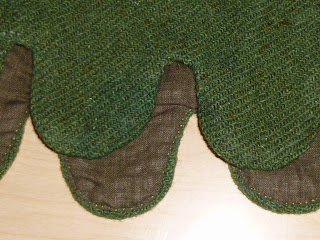
The hem has 28 scallops. After measuring and cutting them, I pinned them with the edges turned in, and stab-stitched around the very edge of the lining. I am certain that real Medieval dagging was not done this way, but it was not my intention to be historically accurate.

(Side note: What does spell-check have against costumers? It didn't accept liripipe or dagging as words. Look what it's fist suggestion for "liripipe" was.
Lipizzaner??
It knows the word for that particular breed of white horse but it doesn't know what a liripipe is. Why is this?)
The outer fabric sticks out about 3 mm further than the lining.
The front closes with 14 buttons. The button loops are made of cotton cord with bias strips of the lining fabric carefully whip-stitched over them.
The buttons themselves are actually little felt balls, a bit smaller than a marble. I wet felted them using green merino roving.
I like the way the loops outline the buttons in brown.
Here is the button closure from the inside.
The garment is lined in a thin brown cotton. The lining seams are the only part that is sewn by machine. There wasn't quite enough of the cotton, so one half of the lining has some piecing it it. The lining ends at the point where the liripipe is attached and is tacked into place.
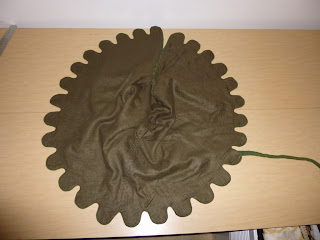
You can't see the piecing in this picture, but it's on the right side.
I like my liripipe hood. Unfortunately, it doesn't really have a place in the wardrobe I plan on having one day, and certainly not with the one I have now. I did wear it a few times last fall, but found the liripipe somewhat awkward.
It got compliments when I wore it, but nobody knew what to call it. I was asked several times if I put my braid in the liripipe. What a dumb question. A braid would obviously not fit in there and even if it did it would be very awkward because the liripipe is so far up on the head.