Pages

Showing posts with label 1770's. Show all posts

Wednesday, 24 November 2021

Unlined Green Linen Waistcoat

 My goodness, still terribly behind on blogging.
I made this waistcoat this spring, because the unlined white linen 1770's waistcoat I made a few years ago doesn't fit me anymore now that my posture is so much better. I have some other waistcoats made from the same pattern that I still wear because they're stiff enough to not pull and wrinkle too badly, but that one is so thin that I can't button it up without it looking absolutely awful.

I re-drew the old pattern and added more width to the front, and took a bit out of the back. The fabric is Everyday Linen in the colour Lagoon from Pure linen Envy. (I'm pretty sure green isn't a historically accurate colour for a summer linen waistcoat, but I made this for my everyday wardrobe so I don't much care.) The facings & pocket flap linings are white cotton sheeting I got from my local Fabricville.

The construction is pretty simple, and basically the same as the previous linen waistcoat. I machine sewed the pocket flaps, leaving the top edge open, then turned them right side out and hand stitched that bit closed with silk thread. I also did a little running stitch along the edge, to help keep it flat. 
I did 3 decorative buttonholes on each flap with matching DMC cotton pearl.

I forgot to take pictures while I was making the pocket. It's a very thin white cotton. I machine sewed one half on all around the opening area, cut it open and turned it to the inside, machine topstitched it, and then machine stitched the other half to the inside.

I wish I'd used a bit of a thicker cotton for the pocket bags, because the one I used was foolishly thin, but since this waistcoat is so soft and unstructured I wouldn't be inclined to put anything too bulky in them anyways.
I whipstitched the pocket flaps on with more silk thread, but not until after the facings were done.
The facings are done in the same way the pocket flap linings. Machine stitched on and turned, topstitched with a small running stitch, then hand sewn to the inside.

Basting around buttonholes before sewing them is one of those Good Habits that I don't usually do, but I did it here because the linen is a bit shifty. It's also somewhat loosely woven, which is why I used a very tightly woven cotton for the facings. 
The buttonholes are overcast in silk thread and then sewn with more of that cotton pearl.
I used the same cotton and some little plastic rings for the 9 Dorset wheel buttons.

Tiny bar tacks at the ends.

The side, back, and shoulder seams are machine sewn and hand felled. The armholes and the bottom edges of the back are hemmed by hand.


I added a piece of facing to the back of the neck too, to prevent stretching and warping.


I wore it a bit this summer and I like it, it's one of my favourite colours. I used the same pattern for my Werther's wrapper waistcoat, and it fits quite well, though I may have added just a little tiny bit too much to the front edge.

Friday, 24 September 2021

1770's Werther's Wrapper Waistcoat (Video)

A few years ago I read The Sorrows of Young Werther (1774), and while I didn't particularly like it, I thought it was a neat coincidence that young Werther famously wears a yellow waistcoat, and I though "huh, wouldn't it be funny if I drew a picture of a 1770's man and glued a lot of Werther's wrappers to the waistcoat part of it?". 

But then I realized I could actually make a real waistcoat covered with wrappers, which is a terrible idea, but the thought that it would make a funny video is what prompted me to actually do it. Here it is, it's 18 and a half minutes long.


I held off posting pictures of this on social media until it was finished because I think it's best to see it with full context so it makes a bit more sense.

Because this is the first complete sewing project I've filmed, I ended up forgetting to take still photos of most steps, so this post won't have as much information as the video itself.

The fronts of the waistcoat are made of thin pale yellow cotton and the wrappers are fused on with heat n' bond. I did several samples before doing the actual waistcoat.

I saved up a lot of Werther's wrappers over a few months (it took 128 in total), washed them, and ironed them flat on a low setting under an organza press cloth. I wanted the gold stripes to be wider than the yellow ones, so I cut the transparent edges off half the wrappers.

I also tried to line up the cut up text on the wrappers
as much as I could.
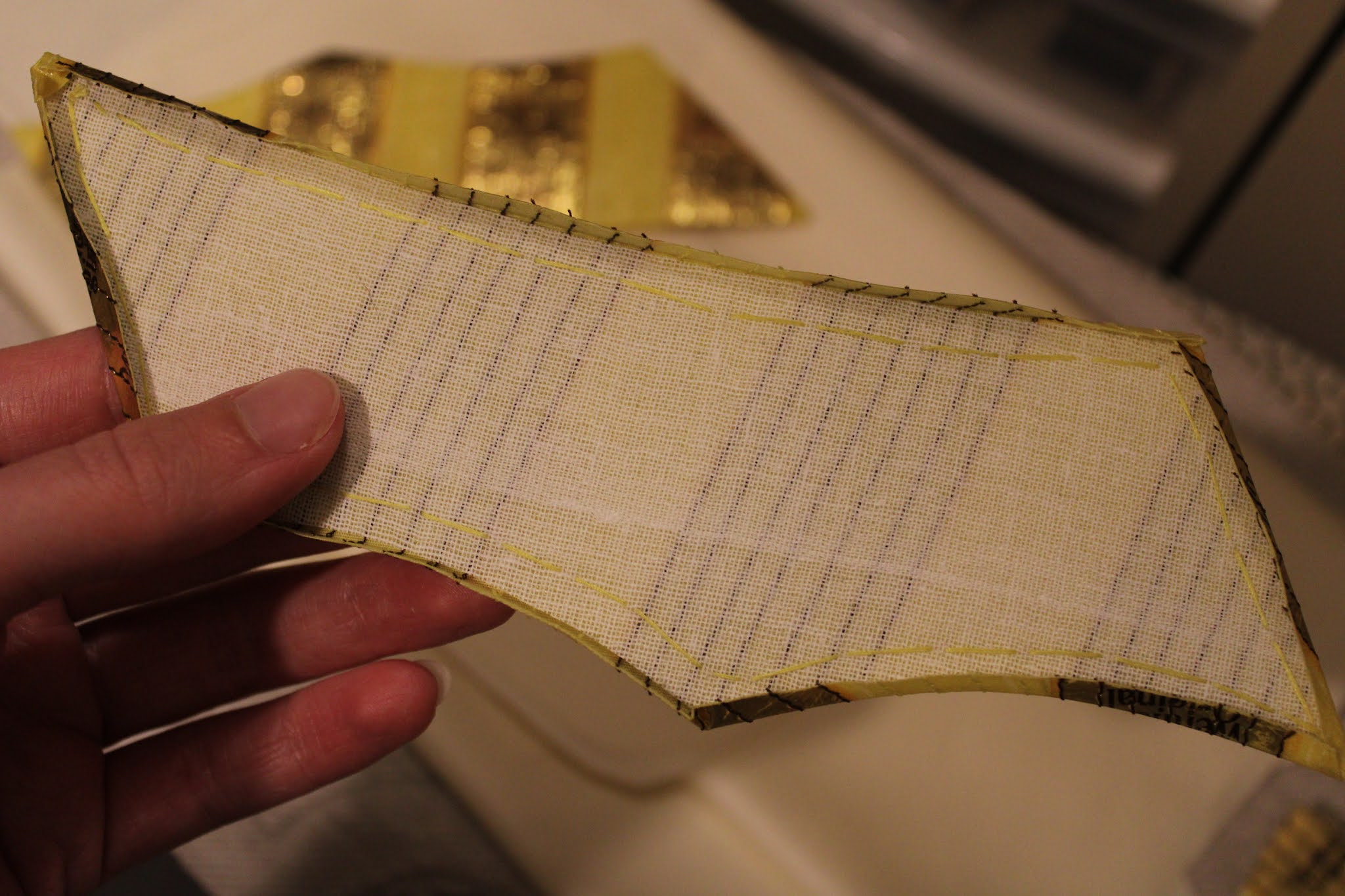
I stuck front and pocket flap shaped pieces of heat n' bond to my yellow cotton and carefully fused each wrapper to it, again using the organza press cloth, and then cut out the fronts and pocket flaps. They were fairly well stuck, but still possible to peel off, so did a lot of lines of machine stitching to secure it. Pale yellow on the pale yellow stripes and dark brown on the gold stripes.


The resulting material was stiff and not very nice to work with. I put very thin buckram in the pocket flaps, much thinner than usual on account of the fabric being so stiff.
The lining is cream coloured cotton sateen, and the construction methods are mostly the same as I usually use. Aside from all the stitching on the stripes, the only machine seams are the two on the pocket bags.

I go over all the construction in the video but will also link to my 1730's waistcoat post (which is a bit different, and I did the buttonhole linings more nicely) and my brown wool 70's one (which is very similar in construction to this one, except for the fact that the back is lined) if you want to read more.

Buckram tacked in.

I made death's head buttons in cotton pearl, with yellow to match that little stripe on the wrappers, and dark brown to match the writing on them.
I did the buttonholes in the same yellow, and regrettably decided to do the thing where you line them after sewing them. The cotton sateen lining frayed more than expected and I wish I'd sewn them after lining. 
If this were a waistcoat made of nicer materials I'd probably do piecing to line the buttonholes like I did with the 30's one, but I put far too much effort into this already!
Not quite my best, but I am pleased with these buttonholes.

I don't like the way these look on the inside!!


The back is a fairly coarse unbleached linen twill from Pure Linen Envy, and is unlined. The centre back seam is hand stitched and felled with grey linen thread.
The top of the back is reinforced with a little scrap of medium weight off white linen.


Here are some badly lit pictures of me wearing it. I went to the trouble of powdering my hair for the video, but didn't want to move half my furniture like I did for the 1730's getting dressed video so I'm just in between the sewing table and the big filing cabinet.
Hopefully someday I will get better photos of me wearing it. For now, I haven't got any 1770's coats to go with it, and 1770's isn't high on my list of priorities, but it's short enough that it could work with an 80's coat. 
(The stripes and multicoloured death's head buttons aren't fashionable for the 1770's anyways.)


It's a very stiff waistcoat and the gold rubs off the wrappers every time I touch it (I think the heat from the iron weakened the print) so I don't imagine it'll get any actual wear. But I am pleased with it and I think the video was worth the time and effort of making it.

Update: The Werther's website has a contact page and I sent them a link to the blog post because I thought they might find it interesting, and they sent me a bunch of candy!

I am pleasantly surprised!