Pages

Showing posts with label petticoats. Show all posts

Tuesday, 16 July 2013

1780's scalloped petticoat- finished

Here are the scallops! A total pain in the butt to sew, but worth it.

I'm not sure how these would have been done in the 1780's. Every extant 18th century garment with scalloped edges that I have ever seen has raw edges that were cut with a pinking tool, but this seems a poor choice for a hem that drags along the ground. Perhaps the whole edge was finished with buttonhole stitches, like cutwork. But these are just guesses. Neither one of those would work on my fraying-prone rayon anyway.

I couldn't find any extant examples of this type of petticoat (plain white petticoats aren't the sort of garment people generally save) so I really have no idea how those hems were made.

Since there wasn't much hope for historical accuracy with this project, I just copied the look as closely as possible. In order to get the hem I wanted I would have to sew some kind of facing to the hem so that the scallops could be turned and all the raw edges hidden away.

I made my first sample with two pieces of the rayon.
Nope. Wrong fabric. Making samples is always a good idea for this very reason.
The different layers of rayon were way too obvious. The drapey nature of the fabric also made the hem wobbly, which was plainly visible even when there was no light shining through it. Something sturdier but more invisible was needed.

I had recently received several big bags of fabric from my mother's friend and amongst all the fabulous natural fibers was a piece of this stuff:
I had no idea what it was but it was sheer and very crispy. I assumed it was synthetic because it had such a plastic like texture.
Yay! Much better.
It worked wonderfully. It was sufficiently sturdy and sufficiently invisible.

It only took 3 strips of the crispy stuff to go around the entire hem. One straight piece for the front and two curved pieces for the back/sides. I had cut the hem to length in a swooping shape so the two curved pieces were cut to match.
I sewed the ends of the front piece of facing to the forward pointing ends of the side/back facing, leaving the two ends at the centre back free. I lined up the centre front points on the front panel and the front piece of facing and pinned the facing all around the hem of the petticoat.
I drew little scallops on the facing in soft pencil. I drew them freehand because using a piece of cardboard to trace them would not have made the finished product any more uniform.

Then I sewed along the whole scallop-y line using a very small stitch length.
7 down, only 99 to go!
It was not much fun.  I could only sew a few stitches before I had to turn the fabric slightly. The presser foot went up and down more times than I can count and the foot pedal became uncomfortably hot from all the starting and stopping. My mother suggested I use the free motion foot, but that would have made it very difficult to control the stitch length and these scallops must be sewn with tiny stitches.
When I stopped sewing there was still a one scallop wide space at the center back where the two free ends of the facing were.
Now I could sew the two ends together in the right place. I pressed the seam open and sewed the remaining scallop.
Only one scallop left.
I trimmed the edges down to a couple of millimeters and cut a notch in between the scallops as far up as I could.

I sprayed the hem with water and turned the scallops inside out.
They bore a strong resemblance to cartoon dinosaur toes.
It was around this time when I noticed that the crispy stuff I had assumed was synthetic was behaving very strangely. I had never known a synthetic to become so limp after being sprayed with water. I did a burn test, and found that it was actually silk. I had never encountered silk organza before, but that's what the crispy material turned out to be!
If I had known that earlier I could have done a better job ironing it. No wonder it took so long to get the wrinkles out on the synthetic setting.
The scallops being ironed.
Ironing the scallops was a bit tricky but it made them very smooth and flat. I turned the edge of the organza down and hand sewed it like a regular hem.
I was afraid that the scallops would pucker and begin to turn inward again the next time they got wet so I went around the hem with edge stitching. It was no fun at all but it made the scallops more secure.
Structurally sound scallops.
From a distance you can barely tell that there is facing.
This picture shows the wobbliest scallop.
The scallops aren't perfectly even but since they average a width of 3 cm I think most of them are pretty good. It's actually hard to see the unevenness when the hem is moving and you are looking down at it.
Just out of curiosity I counted the scallops. There are 106 of them.
I'm so glad it's an even number!
The blue petticoat that I am wearing underneath this one shows through a little. It also doesn't "poof" quite as much as I would like. I'll need to make a few more long white petticoats to wear under this one.
The hem is a bit lower in front than the ones in the fashion plates but it should be at the right level when I eventually get proper 18th century shoes.
You may have noticed that my shift no longer has sleeves. I cut them off in frustration. (Don't worry, 'twas a crappy shift already.) I was working on the toile for my next project, a jacket, and the sleeves of the shift bunched up horribly inside the jacket sleeves. I think that they were too big and baggy.

Does anyone have any advice on making shift sleeves fit under outerwear sleeves?
The Challenge: #15, Colour challenge-White

Fabric: 3.5 m of rayon, 3 not-particularly-big strips of silk organza, 2 very small rectangles of tightly woven cotton.

Pattern: None. I cut the swoop of the hem based on the measurements of the purple petticoat, but with a slightly shorter train.

Year: Late 1780's-early 1790's

Notions: 3.4 m of cotton twill tape.

How historically accurate is it? Not very. The only hand sewing is in the waistband, the pocket slits, the ends of the twill tape and the inside of the hem. The materials are not accurate either. The only accurate thing about this petticoat is the look, which is based on the fashion plates I posted a few days ago.

Hours to complete: 24 hours and 40 minutes. No surprise there.

First worn: July 15th.

Total cost: $0

I am quite proud of the fact that I only spent 3 days sewing this 24 hour petticoat. The 22 hour cap was also done inside of 3 days. I'm not normally able to work so efficiently because I am usually quite sleep deprived (I have terrible insomnia. I can go to bed at 10:00 and still be awake at 2:30) but I slept in that week and so was able to catch up on the challenge.

I finished the petticoat on July 9th which put me 20 days ahead of schedule. The extra time is important because the project I am working on for the next challenge is my first jacket ever and it will take a while to figure out. I am convinced that I can do better in the second half of the HSF than I did in the first. I missed a bunch of challenges, finished a bunch of things late and created some new UFO's. I will make an effort to procrastinate less on the remaining challenges.
I'm working on the second toile now and the pattern is starting to resemble something reasonably decent.
That's all for today. More on the jacket later.

Sunday, 14 July 2013

A start to a scalloped petticoat

There seem to be a lot of scalloped hems in late 1780's fashion. Most of the ones I found are from 1787. There are a variety of colours and scallop sizes.
1787, (source)
 A white petticoat with big scallops.
cabinet des Modes, August 1786 (source)
 A pink petticoat with minuscule scallops.
This one didn't come with any information but I'm guessing late 1780's. (source)
 Another white petticoat with medium-small scallops. Please note that this gown has BUCKLES across the front and that they are a design feature of significant awesomeness! I will most certainly be making a late 1780's something with buckles on the front someday (Once I find the right buckles).
Magasin des Modes, April 1787 (source)
 Big scallops again, and this one has a bit of a train.
Magasin des Modes, December 1789. (source)
A matching scalloped gown and petticoat.
Magasin des Modes, July 1787. (source)
 More tiny scallops.
Magasin des Modes, April 1787. (source)
 And more tiny scallops.
Magasin des Modes, August 1787. (source)
 And even more tiny scallops.
Magasin des Modes, August 1787. (source)
These ones look more like zig-zags, but it's the same general idea.

I adore the white petticoats with the small scallops and have wanted one for quite some time. The "White" challenge provided the perfect excuse to make one.

The fabric is a nice white rayon. It's soft and drapes beautifully, which of course makes it extremely annoying to work with. I divided the length into a 1.95 m section and a 1.54 m section. The longer one is for the back so that it fits over my overstuffed false bottom. The cut edges frayed like crazy so I put narrow hems on them.

Making narrow hems.
 I tried to make them with the hemming foot on my sewing machine, but I have yet to use that thing successfully and it mangled the samples just like it always has.
The one on top is the one that the foot wrecked, the one below is the one I made by folding the edge myself.
 The hems came out a bit wobbly but they kept the edges from fraying.
The inside of the seam, the fabric is thin but the lines aren't too obvious.
 I made pocket slits the same way I made the ones for the purple petticoat, except I didn't have to turn the edges in.
Lots of little pleats. I just love itty bitty pleats!
 Unlike the thick cotton of the previous petticoat I made, this thin, shifty fabric required a waistband. I used a fine but tightly woven off white cotton from my Grandmothers stash.
My stock of twill tape has all but dried up. I had to piece the longer section of tape together out of two pieces with different widths. I had hoped it would end up inside the waistband but it was too far off center.
The tape works just fine and isn't visible when the petticoat is being worn so it doesn't bother me all that much.
I have split this project into two posts because there are a lot of pictures. The next post is about the hem.

Monday, 10 June 2013

Purple Petticoat

My 1780's petticoat is finished! It's actually been finished since Friday night, it just took a while to get good pictures of it.
I'm working on a purple pierrot jacket and this is the petticoat to go with it. Here is my main inspiration picture.
Journal de luxus, 1791. (source)
I am not copying the plate exactly, I'm using it here because it's the closest fashion plate I have found to my design, but I'll talk about the pierrot in another post.

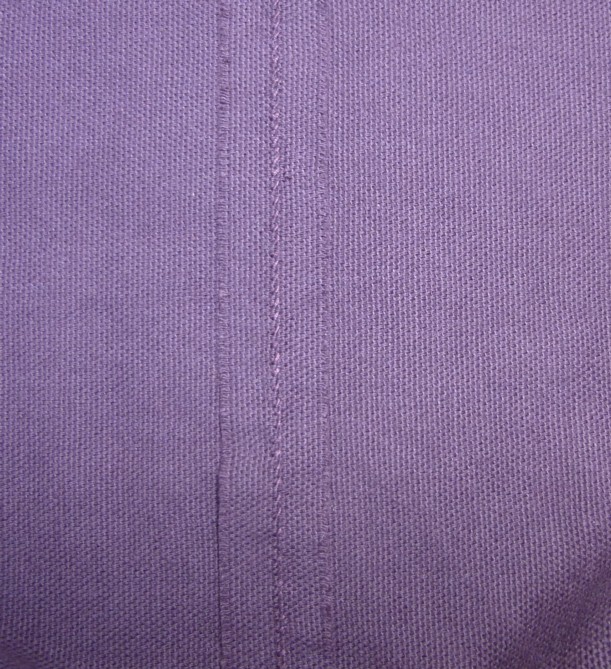
The petticoat is made of a cotton drapery fabric that was in the "buy 1 metre get 2 free" pile. I cut two sections for my petticoat, 44" for the front and 84" for the back, I cut along one thread so that the side seams would be perfectly straight. The basic construction of the top part is taken from this tutorial by American Duchess, but the rest I did quite differently.
I made pocket slits and sewed down the sides, stopping about a foot from the bottom because I hadn't cut it to length yet and didn't want to cut through a seam.

One of my pocket slits. You can just see where the narrow hem stops, at the bottom of the picture.
The petticoat is entirely hand sewn. I used whipstitching, which I read about in this article from extreme costuming. I'm not sure if it was used on 18th century petticoats, but it worked really well.

The seam from the inside.
The seam from the outside.
I waxed every bit of thread I used, and doubled it for extra strength, and I am thrilled with how these seams turned out. They didn't even need ironing! Whipstitching is awesome!

I pleated the top edges and used more whipstitching to hold the tops together. I tried to pleat the front section down to 7 inches, which is how long it was when it was pinned, but it somehow shrunk to 6 inches after I sewed it.  I had to make the back section longer, which was a good thing because there is almost twice as much fabric in the back. I put in a row of stab-stitching just above the lower edge of the selvedge.
Knife pleats. It's kind of hard to see, but there is whipstitching on the top and stab-stitching a little lower down.
I folded the edge of the twill tape over the top of the pleats so that the bottom edge would be above where I thought the waistband would end. I attached the folded top piece with a row of stab-stitching and the bottom row with whipstitching. I put some more stab-stitching above the whipstitching, just to make it extra secure. It was at this point that I realized that a waistband would be completely unnecessary and would add way too much bulk to an already bulky apparatus. So my petticoat has no waistband.
A close up of the 3 rows of stitching attaching the twill tape.

The non-waistband. The longer section on the left is the back.
I put the petticoat on over my stays and bum pillow and pinned up the hem to the approximate height that I wanted it. This was not easy, seeing as I have no dressmaker's dummy of any kind, and the fabric dipped lower whenever I reached down to pin it. I got my father to look at the hem to make sure it was at the proper height and then I cut the excess fabric away, leaving 4 inches to be turned up.

The excess fabric consisted of a rectangle and two triangles, which is good since this is for the squares, rectangles & triangles challenge. The rectangle was removed from the front panel, and the two triangles came from the forward edges of the back panel. I left the middle of the back the full width of the fabric, since it has to have a train and go over a bum pillow.
A rectangle and 2 triangles. The rectangle is actually slightly wider in the middle.
The extra length having been removed, I then finished sewing the side seams. I pinned the hem up again. I made the hem almost 4 inches wide in the front, and a little narrower in the back. This is so that I can adjust the length, if I need to, when I get proper 1780's shoes. Right now I'm using my Grandfather's old shoes, which are only slightly too big and have about an inch of heel. They don't resemble any kind of women's shoe but they're the only "nice" footwear I have.

 Hemming the front section proceeded smoothly, but when I reached the side seams I realized that I could not possibly turn up an edge that curved downwards at such an angle.
I had not thought this through.
I was quite distressed for several hours, until I came up with a solution- a sneaky hem godet!
I picked out the end of the seam, stopping less than 1 cm above the folded edge. I cut a triangle of scrap fabric and set it in the end of the seam. Problem solved!

The unpicked seam end and the triangle that it will soon receive.

A sneaky hem godet.
It smoothed out very nicely.
The sneaky hem godet from the outside, after ironing.
The curved part near the back required a bit of gathering. It shows through a tiny bit more than the hem godet does, even though I covered the ironing board with a towel. Perhaps I pressed down on the iron a bit too hard.
Gathers near the back of the train.

And here is the finished petticoat. The front just grazes the ground, while the back drags behind in a pretty train, sweeping up all kinds of dust bunnies and any other nasty things that may have dropped onto the floor.
I now understand the purpose of a balayeuse, which unfortunately seem to be from a later era.
From the front.

From the side.
From the back.

The Challenge: #11-Squares, rectangles & triangles.


Fabric: 3.25 m of dark purple cotton drapery fabric. The label said unknown fibres, but I said cotton and a burn test agreed with me.

Pattern: Draped with some ugly old curtain panels that I cobbled into a sort of petticoat, You can see it in the silly hat post, I took the basic measurements from it. I've been wearing it since I have a deficit of petticoats but I really need to make some proper ones to replace it.

Year: Late 1780's- very early 1790's.

Notions: 334 cm of white cotton twill tape.

How historically accurate is it? The look is accurate and so is the hand sewn-ness of it. My construction method is probably not accurate, but it would have been entirely possible with 18th century materials. The fabric is not accurate.

Hours to complete: 19 hours, 23 minutes.

First worn: Saturday (2 days ago)

Total cost: Well, the fabric worked out to a little more than $3.00 per metre, and I used 3.25 m, so maybe about 11 or 12 dollars (Canadian).

Friday, 22 February 2013

18th century quilted petticoat

This is one of the few sewing projects that I consider to be evil.

Evil.
 A few years ago my aunt gave me two pieces of silk for Christmas, one was a dark blue and the other a pale yellow. It wasn't a yellow that I particularly liked, about the same colour as the interior of a banana. So I washed both fabrics together, hoping that the dye would run and turn the yellow fabric greenish, and it did. It came out a lovely seafoamy green. I found two extant petticoats in almost the exact same colour. It measured about 84x205 cm, plus a small rectangular scrap, which seemed like a perfect size for a petticoat, so it turned into a quilted petticoat project.
My sketch for the pattern around the hem.
The fabric is 80 inches long, plus seam allowances, so there are eight 10 inch fish around the hem(yes, I'm going to keep switching between Metric and Imperial depending on which one is more convenient).
I stretched the fabric out on a big table, holding the edges down with masking tape, and transferred the pattern on with carbon paper. I turned it over and attached it again, spread cotton quilt batting over it, and muslin over that. I basted all the layers together, with the rows of basting about 5 cm apart. Then I started quilting, and shortly thereafter wondered what the hell I had gotten myself into.

The hem pattern, it takes up about 1/3 of the petticoat.
The batting was too thick for running stitches, I tried it on a sample and they came out too big, and I'm far too stubborn to machine quilt it. So I'm stab-stitching the whole thing. That means the needle goes straight up and straight down again, through all the layers, with every single stitch. The stitches are about 1-1.5 mm long so it's going rather slowly.
I don't know what I was thinking. It's not even a good quality fabric, just a slubby dupioni that's thinner in some places than others.
The background behind the fish. It's meant to look like seaweed and bubbles. The yellow dust is the chalk.
 Some of the lines aren't included in the carbon paper pattern, the scales on the fish and the background are drawn on with chalk, a little at a time.
Drawing on the seaweed lines.
I draw the lines with a chalk line maker; it makes nice thin lines, plus it's refillable, so I use it for pretty much anything that requires chalk.
The chalk lines, they're a bit hard to see so the light has to be really bright in order to work on these parts.
Stitching along the seaweed lines.
For the fish scales I draw a bunch of lines from it's head to it's tail and use them to get the scales lined up correctly. I haven't got room for a quilting frame, so I'm using a hoop.


Once I'm finished the fish, seaweed, bubbles, and the swirly borders above and below them, I'll fill in the rest of the petticoat with a large fish scale pattern. I've seen a similar pattern on extant 18th century petticoats(like the one on page 86 of the big KCI book), only they were facing upwards. I don't have documentation for the fish pattern but I don't think fish are implausible. This crazy extant petticoat has lions, horses, trees, deer, birds, and mermaids around it's hem.
 Judging from the dates in the sketch book, I started it sometime around April 21st/2012, and this is all I've finished so far.
3 fish and a bit of background.
Admittedly, I have been avoiding it for the past few months, and before that I didn't work on it every day. But I started working on it again after I took the photos for this post. I'm not keeping track of the hours I'm spending on this thing, it would be too depressing. I did time one of the fish though, it took 8 hours and 45 minutes.
I'll report back once I finish the hem design and start the scale pattern on top.