Pages

Thursday, 13 February 2014

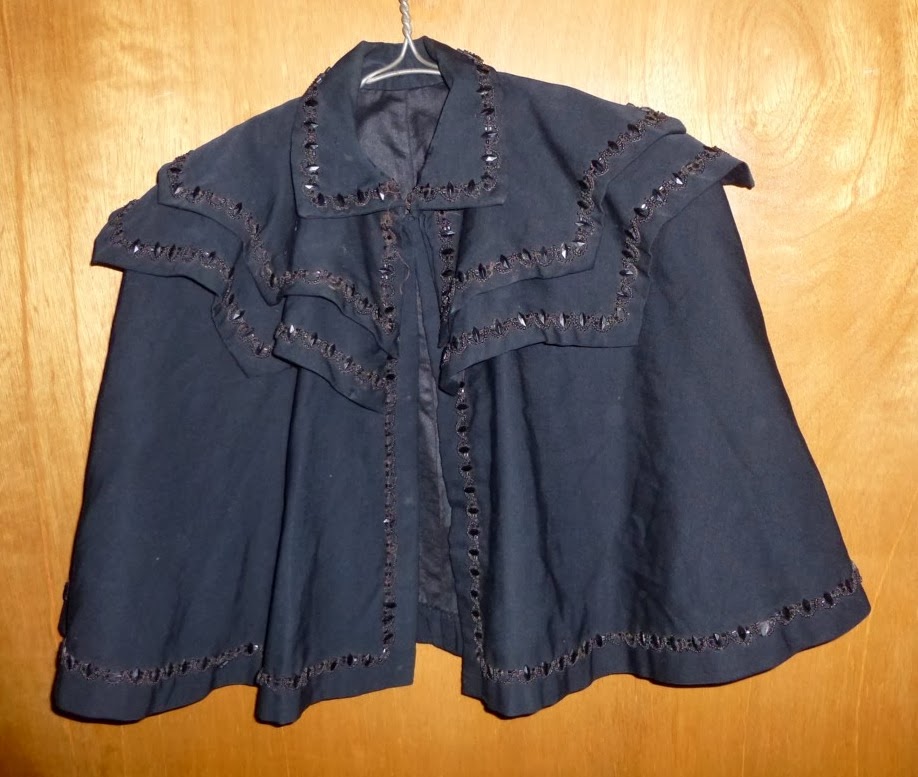
Black Beaded Capelet

I apologize for my absence.
I have been busy with school things again and am behind on my own sewing projects.
I am not off to a very good start on the HSF '14. The first project was late, I missed the second one, and there is no way I will finish the third one on time. As I am frequently informed that school is the higher priority, I will not be able to complete as many of the challenges as I would like. I am, however, hoping to have a linen shirt finished in time for #4.

Now, since I have no posts on actual sewing, here is another thing from the Old Stuff Collection. I found this capelet in a trunk in my Grandparent's attic.
Isn't it marvelous? It would have looked very nice with the reticule that was in the same trunk.
I'm not sure what date it's from, but it looks like either very late 19th century, or very early 20th century. There were tiered capelets around at that time, but I haven't seen any others with inward curves and beads, nor with this kind of spacing. I am not particularly knowledgeable about this era. Can any of you help narrow down the date?
Madame Demorest's Illustrated Portfolio of the Fashions For 1880.  (Source)

The Ladies Home Journal, March, 1898. (source)
The large piece is about 3/4 of a circle. The two smaller ones are a bit longer. All three tiers are seamed in the centre back. The major seams are all machine sewn.
There is one hook & eye closure at the base of the collar.
I'm not exactly sure what the fabric is, but judging from the rough texture I think it might be a very fine wool.

The beads are a pre-made trim that has been couched on. It has 3 different kinds of glass (or maybe jet?) beads. Many of the large ones have fallen off.
The stitching holding the trim on is uneven and shows on the wrong side in a few places, especially under the collar. It's attached with brown thread.
You can see the couching in this picture.
The third point on the top tier is tacked to the middle tier, but only on the right side. The left side was probably tacked at one point.
The middle tier is tacked to the front edge of the bottom tier, just past the trim.
It's attached on both sides.
There is quite a bit of wear on the back, under the collar. Other than that, and the missing beads, it's in pretty good condition.
The lining is a very shiny cotton twill. The hems of the top two tiers are very nicely finished with wide bias strips of the same materials.
The hem of the bottom tier is simply turned up once and finished with a cross stitch.
The collar is almost perfectly rectangular, and doesn't feel like it has much stiffening in it at all.
You can see the hook in this picture, attached with a big snarl of brown thread.
There are two darts at the shoulders. They are sewn through both the lining and the outer fabric, slashed open, and whip-stitched to the inside.
It looks as though whoever made this capelet ran out of black thread before they were finished.
This dart is finished partly in black thread, and partly in brown.
I don't know what sewing project I will be finishing next. I just drafted a frock coat pattern and I'm super exited about it, so I would really like to make a frock coat. Perhaps the grey one with the zig zags.

Sunday, 2 February 2014

The Surprise Cookbook, 1868?

I've been meaning to post about this book for months.
I found it when we were packing up Grandma and Grandpa's books. (For the record, they're not actually dead (Update, 2018: now they are), they just moved into an assisted living place.) I snatched the book up when I saw it, because it was clearly very old.
It's in pretty bad shape. The spine has fallen off and the pages are barely clinging together.
There are 3 dates written on the inside cover in pencil. The first one is 1929, which can't possibly be the publication date. Under that there is "1868", and under that "61". Judging from the contents, I am willing to believe that this book is indeed from the 1860's.
There isn't any publication date. They don't even give the author's name or the country in which it was published(though it's quite obviously from England).
There is, however, a very snobbish dedication.
Though I'm showing it here, it actually appears after the index.
"Dedication.
To Those Housekeepers
Whose patience has been often tried, and their materials wasted, in
attempts to follow the impractical directions contained in cookery-books
written with delicate fingers, and based upon French
and other foreign writers,
This Volume,
(Expressley and painstakingly prepared for those who would have good
living without an exorbitant outlay of time and money, and
free from the risks of mere "experimenting")
Is humbly dedicated
by
The Author"

Humbly dedicated indeed. Those "French and other foreign writers" were probably publishing much better recipes than these ones at the time this book was written. Just look at how much of this stuff is boiled.
I made the pictures bigger than usual, but you still might need to click some of them for a larger image.
Apologies for the mangled and stuck together edges.

The end of the index has a couple of lovely pictures. Unfortunately someone has scribbled on one of them with a purple crayon. At least half of the illustrations in this book suffered the same fate.
A cow and sheep. Aren't they pretty?
Rather than scanning these pages, I am photographing them. The images aren't as nice as scans would be, but scanning would require bringing it to school, opening it, and turning it upside down multiple times. The book is in no condition for that kind of handling.
I'm not blogging the entire book. Ideally I would like to make the whole thing available online, but for now I've just skimmed it and photographed the bits that looked most interesting.
The first chapter was Meats. There was too much boiling. Ick.
At the beginning of the next chapter I found the spine.
No sense in trying to reattach it, but it's nice to know it isn't lost.
At the beginning of each chapter there is page or two of general observations or general remarks.
It's interesting to see instructions on dealing with freshly killed fowl.
Ashes? Is that safe? I suspect that some of these recipes are more than a little poisonous.
The picking chapter covers just about every kind of meat and vegetable there is.
I'm familiar with pickled cucumbers, and pickled onions, but not oysters. Oysters make quite a few appearances in this book. There are also a lot of things that are tied with bladders.
I wonder how well the Mock Turtle Soup imitates turtle. Never having had turtle or calf's head I couldn't begin to guess.
The rest of this recipe is on the next page, sorry!
Some of the recipes have highly amusing names.

Oysters again.
And even more oysters! I seem to recall a lot of oysters in Dickens's books as well.
Tucked in between the pages of the fish section, I found a piece of paper.
It was so exciting!
On it was a handwritten recipe for soap.
It looks like they started writing it on the other side, but then scratched it out and started over on the other.
That's the first 25 of the 119 pictures I took of this book. I'll post some more of them later.
If you find something in the table of contents that you would like to see, just ask me and I'll make sure it gets posted.

Saturday, 25 January 2014

Fur Trimmed Waistcoat, Finished

It's finished! 9 days late, but finished.
As sewing projects go, this one was particularly frustrating.
In the last post on this, I was in the process of attaching the pockets. I stitched through both the welt and the pocket bag with a stab stitch.
The front half of the pocket bag sewn to the waistcoat.
I cut the wool under the welt at an angle, going as close to the corners as I could.
The back of the pocket, just before turning it to the inside.

The pocket after being turned to the inside.
I sewed down the ends of the welt with more stab-stitching.
The ends of the welt after being sewn down.

The second half of the pocket bag, pinned on.
I sewed the second  half of the pocket flap onto the wool bits at the top with a stab-stitch, and onto the rest of the pocket bag with a double row of running stitches.
The completed pocket, from the inside.
The fabric is sturdy, so hopefully this will not wear through. I hate it when clothing manufacturers use thin, cheap material for pockets and they wear out before the rest of the garment.
The finished pocket from the outside. There is a bit of a gap, but the fur hides it.
It was only after the second pocket was nearly complete that I realized the welts were a stupid waste of time. These pockets are right on a seam. There was no need for welts. I could have just sewn the pocket bag to the seam. The welts did nothing more than add a lot of bulk. What was I thinking?
It was too late by that point. I suppose I could have re-cut the bottoms from the sleeves of the coats, but that would waste even more time and wasn't really worth it.
I folded all the edges in and whip stitched them down. I did the same to the seam allowances, because they would not lie flat, and I didn't want lumpy seams.
I pad stitched the interfacing to the lining.
I don't know what the accurate method of interfacing waistcoats is, but I think now that they used fewer stitches. I don't recall having seen an extant waistcoat that was so pockmarked on the inside.
This picture doesn't show the pockmarks very well.
I sewed the lining together with a running stitch, leaving the shoulder seams open.
I pinned the lining in all at once, with the edges tucked in.
I whip stitched the edges, and sewed up the shoulder seams with a ladder stitch.
I did it this way because I didn't want the armholes to be the wrong size and mess up the way the whole lining fit into the waistcoat.
I was about halfway through stitching the lining in when I realized that the hideous pink wool I had made the back from was dyeable. Why did I not think of this sooner? I have dyed wool before.
I finished putting the lining in, and dunked the waistcoat in a pot of red dye. I tried to keep the front out of the pot, so that the back would soak up most of the dye.
It came out a decent shade of red, though I think there are a few bits of some other fiber in there, since some of the hairs are still white.
The dyed back against the original colour.
I had machine washed the wool before starting, so all the hot water didn't affect it much. It just made the pockets a bit wrinkled.
The middle buttonhole is half finished.
The buttonholes came out looking rather sad. It's hard to get nice looking buttonholes in thick, fuzzy material.
The 12 buttons I used were originally from my Grandma's stash. They have brown metal frames and fabric covered centres. There were bits of thread indicating that they had been previously used, so they also count as make do!
Since the fabric is very thick, I made little wrapped thread shanks. (This is actually in the wrong order, I made the buttonholes before attaching the buttons, as one does.)
After attaching the fur to the front edge of the buttonhole side, I secured the fur around the buttonholes. I marked them one at a time, cut around the buttonhole marks, and sewed the fur to the edges of the buttonholes.
It was horrible, until I clued into the fact that beeswax is sticky and was causing more trouble than it was worth by sticking to the fur. I stopped waxing my thread, and it was much better after that.
I also found this great little wire rake in my box of inherited sewing tools. It really helped move the hairs out of the way.
It is marked "Fuller".
All the fur is attached with whip-stitching.
I only put fur down one side of the front, unlike the one in the fashion plate, which has two distinct strips of fur. (Similarly, the feathered trim on this waistcoat is also in two strips, with buttons on one side.)
Finished!
It took a lot of effort to not toss this thing on the UFO pile. The fur was frustrating to work with and there were three moments of "Arrg, what was I thinking?", which is quite a high number for a single project.
I like this waistcoat. It's very warm, and the fur hides the buttons almost entirely.
I really need to make some shirts. This one is far too modern, besides being nearly worn out.
You may have noticed that my hair is no longer down to my butt. I got 12 inches of it cut off. This was my first haircut in over a decade and I like it much better this way.
It's not the most flattering of garments on it's own, being made of bulky wool with straight seams and two big horizontal stripes, but it looks good when worn with a coat.
I attempted to copy the pose of the fashion plate guy, but the angle was wrong. (I am putting the fashion plate information here because the pictures won't stay side by side if they have captions- Magasin des Modes, February, 1788- Source.)
The breeches I'm wearing are actually cut off corduroy pants, and the coat is one I've had for years, so it doesn't have the right cut at all.


The Challenge: #1, Make Do & Mend
Fabric: Red wool from a second hand coat, pink (but not anymore) wool from a blanket, Brown linen.
Pattern: Drafted by me.
Year: 1788
Notions: An unidentified fur object, a bit of hair canvas, 12 metal & fabric buttons, thread(cotton, linen and polyester).
How historically accurate is it? Fairly accurate. The wool, linen and fur are pretty accurate (aside from all the little serger seams on the fur). The buttons and some of the threads aren't. I guessed at the construction, but I think it's mostly accurate.
Hours to complete: 52:42
First worn: Friday, January 24th, 2014
Total cost: The hair canvas was the only thing I bought, and it probably works out to a few cents because I used so little.

There isn't very much snow at the moment. We had two feet a few weeks ago, but it got rained on.