Pages

Sunday, 26 September 2021

18th Century Cloth Covered Buttons (Video)

A little over a year after making a Death's head button video, I've made one on cloth covered buttons too!


It's just over 12 minutes long and shows how to make an ordinary covered button, then how to centre a motif on a button, then some tips for bulky fabric, and then how to sew them on.

The first time I made a coat with covered buttons, way back in 2014, I didn't know you could buy button moulds so I used discs that I sliced off an old hardwood chair leg with a hacksaw and whittled and sanded down. (And the chair leg was tapered, so I had to whittle some down a lot to make the size consistent.) Much better to just buy wooden discs.

Places that sell reproduction button moulds:

Burnley & Trowbridge - Wood, bone, and horn ones!

I've ordered wood and bone moulds from them a few times, and I love this shop and I think the people who run it are very nice, but I have to be honest and say that I don't think the small wooden button moulds are very good quality (especially for the price they are). The edges are quite thin and the grain of the wood very large and a bit splintery, so sometimes the edges are a bit rough, and I usually sand them down before using them.
(B&T if you're reading this I am sorry!! I really love most of the stuff in your shop, and also your youtube tutorials! I just do not love the smallest size of wooden button mould.)

The bigger wooden moulds are better though, and the bone ones vary in thickness but I like them. I also got my fine linen sewing thread from there. I haven't got any of the horn moulds but they look really nice in the photo.

Wooded Hamlet Designs - They appear to just have thick domed wooden ones in 3 sizes.

Gina B Silkworks - Haven't bought any of these but it looks like there's a good variety of shapes and sizes.

Wm. Booth Draper - Wood and bone moulds that look similar to the Burnley & Trowbridge ones, but I haven't bought any of these either.

Etsy shops with wooden discs & beads that are also good for covered buttons:

The stock in these sorts of stores can change quite a lot, so some of these links might not lead to button moulds if you're reading this sometime in the future. I got a lot of big 1.5" discs for coat buttons from SnugglyMonkey a few years ago, but they haven't got any right now. I have found the same discs in a few other shops though. Searching for "unfinished wood disc" or "flat wooden bead" or similar ought to bring up plenty of button mould options.

Like I mentioned in the video, I find these are much more affordable than the ones specifically sold as reproduction moulds, and often come in a wider variety of sizes. The reproduction moulds are sold individually, but these come in larger amounts.

TownletBead - SO MANY wooden discs and flat wooden beads and domed half-ball shapes! Such a wide variety of sizes! The ones I got were really wonderful smooth hardwood, and perfectly uniform. (Except for one of the packets which was a bit of a rougher wood and had some that had warped into a slightly oval shape, but that was all perfectly visible in the photo of that listing, so just look closely at the photos and you should be fine.)
They ship from China so it took about a month for the moulds to reach me in Canada (the plague has slowed down shipping times) but it was absolutely worth the wait! Excellent button moulds!! If you need to stock up on button moulds, this is the place that I'd recommend most highly.

Look at those little ones in the middle left!
They're 1cm across but still perfectly smooth and round.

WillowRunCrafts - Big wooden discs with nice rounded edges like I used for my coat buttons! They've got a few sizes and they come in bulk. You can get 50 of the big coat button moulds for less than 9 dollars!

FenFenAccessories - You'll have to scroll through pages and pages of other beads to find them all, but they have some little discs and dome shapes.

DIYartworld - Again, pages and pages of other beads, but there are some nice little discs with holes and some domes in there. 

For shops like that it's easiest to just scroll through all the beads and favourite any that are button-able so they'll be easy to find again.

smallcommodity - Same as the previous two. Many pages of beads and a few of them are great button moulds.

VeryCraft - Same again. Lots of beads, a few good moulds.

2015shopopen - Same again.

There are other shops that have suitable button moulds, these are just the ones that appear to have the most at the moment, as far as I've been able to find. I definitely recommend saving lots of moulds to your favourites! It's nice knowing there's a wide variety there that are easy to find again.

I haven't looked around much at craft supply stores that aren't on etsy, but I imagine there are probably some out there that also have good moulds.

Update: I have been informed that the etsy ones can be found wholesale on Aliexpress, and have made a list!

Here are all the images I used in the video, with source links. (I'm sorry they're not in order!)

Waistcoat, 1770-90, French. Cotton.

Coat, 1780-90, French. Silk.

Suit, c. 1760, British. Silk.

Waistcoat, c. 1740, British. Silk.

Coat, British, c. 1735. Wool and silk.

Waistcoat, 1775-80, French.
Silk, linen, cotton.

Waistcoat, European, c. 1780's. Silk.

Coat, 1780-89, French. Silk.

Waistcoat, European, silk.
No date given but I'm guessing 1780's.

When talking about button mould prices I also included a tiny screenshot from The General Shop Book: Or, the Tradesman's Universal Director, 1753, which is on Google Books.

The small buttons I'm sewing onto the waistcoat at the end are for a version of this printed 1780's waistcoat from Villa Rosemaine.

(The fabric for mine was a birthday present, originally from Summer Sun Stories. It came with little ship's wheel button covers but I painted my own covers because I wanted the same buttons as the original.)

Friday, 24 September 2021

1770's Werther's Wrapper Waistcoat (Video)

A few years ago I read The Sorrows of Young Werther (1774), and while I didn't particularly like it, I thought it was a neat coincidence that young Werther famously wears a yellow waistcoat, and I though "huh, wouldn't it be funny if I drew a picture of a 1770's man and glued a lot of Werther's wrappers to the waistcoat part of it?". 

But then I realized I could actually make a real waistcoat covered with wrappers, which is a terrible idea, but the thought that it would make a funny video is what prompted me to actually do it. Here it is, it's 18 and a half minutes long.


I held off posting pictures of this on social media until it was finished because I think it's best to see it with full context so it makes a bit more sense.

Because this is the first complete sewing project I've filmed, I ended up forgetting to take still photos of most steps, so this post won't have as much information as the video itself.

The fronts of the waistcoat are made of thin pale yellow cotton and the wrappers are fused on with heat n' bond. I did several samples before doing the actual waistcoat.

I saved up a lot of Werther's wrappers over a few months (it took 128 in total), washed them, and ironed them flat on a low setting under an organza press cloth. I wanted the gold stripes to be wider than the yellow ones, so I cut the transparent edges off half the wrappers.

I also tried to line up the cut up text on the wrappers
as much as I could.
I stuck front and pocket flap shaped pieces of heat n' bond to my yellow cotton and carefully fused each wrapper to it, again using the organza press cloth, and then cut out the fronts and pocket flaps. They were fairly well stuck, but still possible to peel off, so did a lot of lines of machine stitching to secure it. Pale yellow on the pale yellow stripes and dark brown on the gold stripes.


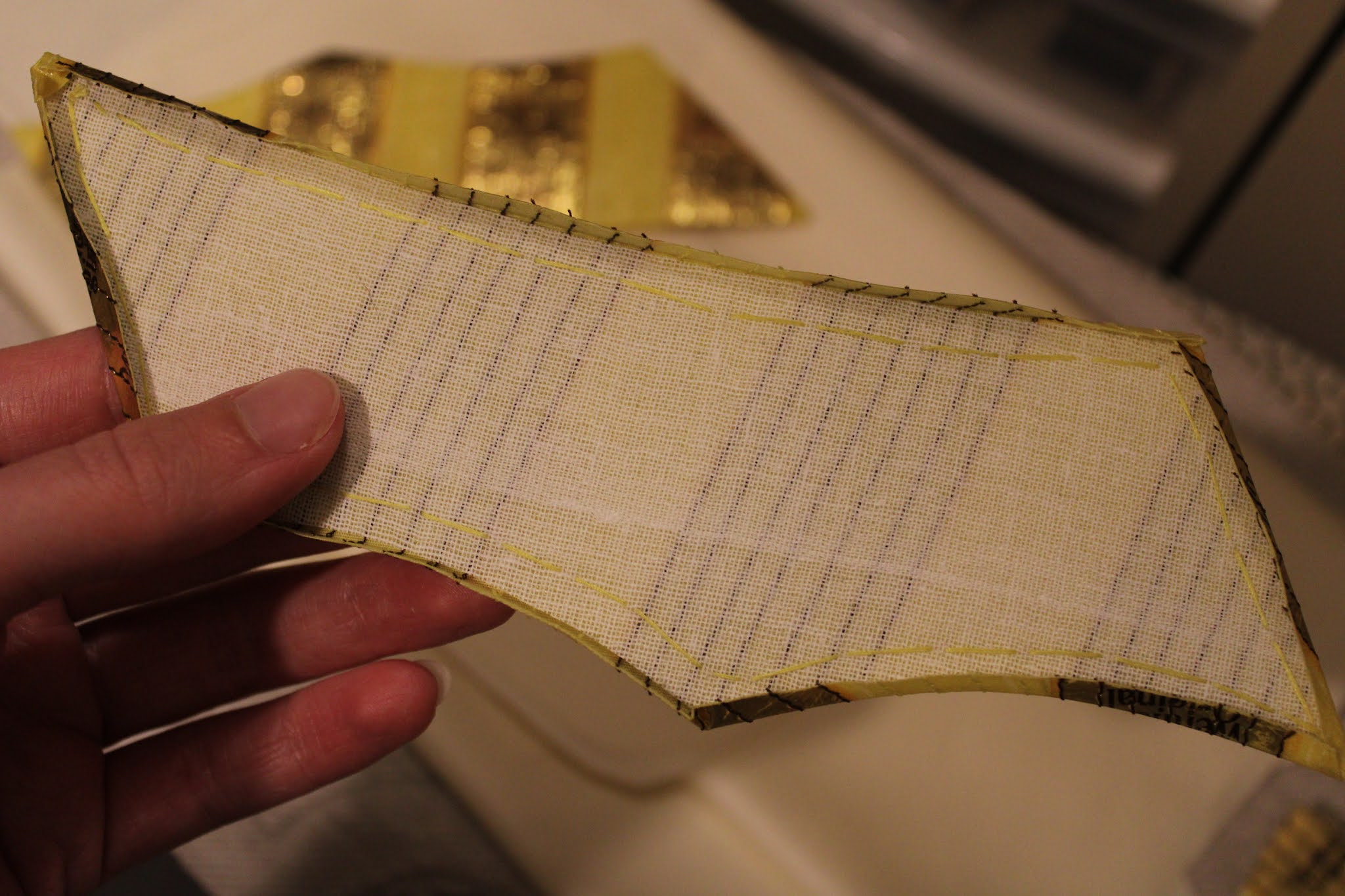
The resulting material was stiff and not very nice to work with. I put very thin buckram in the pocket flaps, much thinner than usual on account of the fabric being so stiff.
The lining is cream coloured cotton sateen, and the construction methods are mostly the same as I usually use. Aside from all the stitching on the stripes, the only machine seams are the two on the pocket bags.

I go over all the construction in the video but will also link to my 1730's waistcoat post (which is a bit different, and I did the buttonhole linings more nicely) and my brown wool 70's one (which is very similar in construction to this one, except for the fact that the back is lined) if you want to read more.

Buckram tacked in.

I made death's head buttons in cotton pearl, with yellow to match that little stripe on the wrappers, and dark brown to match the writing on them.
I did the buttonholes in the same yellow, and regrettably decided to do the thing where you line them after sewing them. The cotton sateen lining frayed more than expected and I wish I'd sewn them after lining. 
If this were a waistcoat made of nicer materials I'd probably do piecing to line the buttonholes like I did with the 30's one, but I put far too much effort into this already!
Not quite my best, but I am pleased with these buttonholes.

I don't like the way these look on the inside!!


The back is a fairly coarse unbleached linen twill from Pure Linen Envy, and is unlined. The centre back seam is hand stitched and felled with grey linen thread.
The top of the back is reinforced with a little scrap of medium weight off white linen.


Here are some badly lit pictures of me wearing it. I went to the trouble of powdering my hair for the video, but didn't want to move half my furniture like I did for the 1730's getting dressed video so I'm just in between the sewing table and the big filing cabinet.
Hopefully someday I will get better photos of me wearing it. For now, I haven't got any 1770's coats to go with it, and 1770's isn't high on my list of priorities, but it's short enough that it could work with an 80's coat. 
(The stripes and multicoloured death's head buttons aren't fashionable for the 1770's anyways.)


It's a very stiff waistcoat and the gold rubs off the wrappers every time I touch it (I think the heat from the iron weakened the print) so I don't imagine it'll get any actual wear. But I am pleased with it and I think the video was worth the time and effort of making it.

Update: The Werther's website has a contact page and I sent them a link to the blog post because I thought they might find it interesting, and they sent me a bunch of candy!

I am pleasantly surprised!

Monday, 30 August 2021

Three Sleeveless Nightgowns

I used to have a couple of sleeveless cotton nightgowns, but they wore out, so this summer I made 3 new ones. One of the ones that wore out is the nightgown I altered and drew monsters on a few years ago (The top part wore out, but I still have the bottom part with the monsters) and the other was a very similar one in thin cotton.

It was ripped in a few places, and I cut it up and traced those pieces to get my pattern.

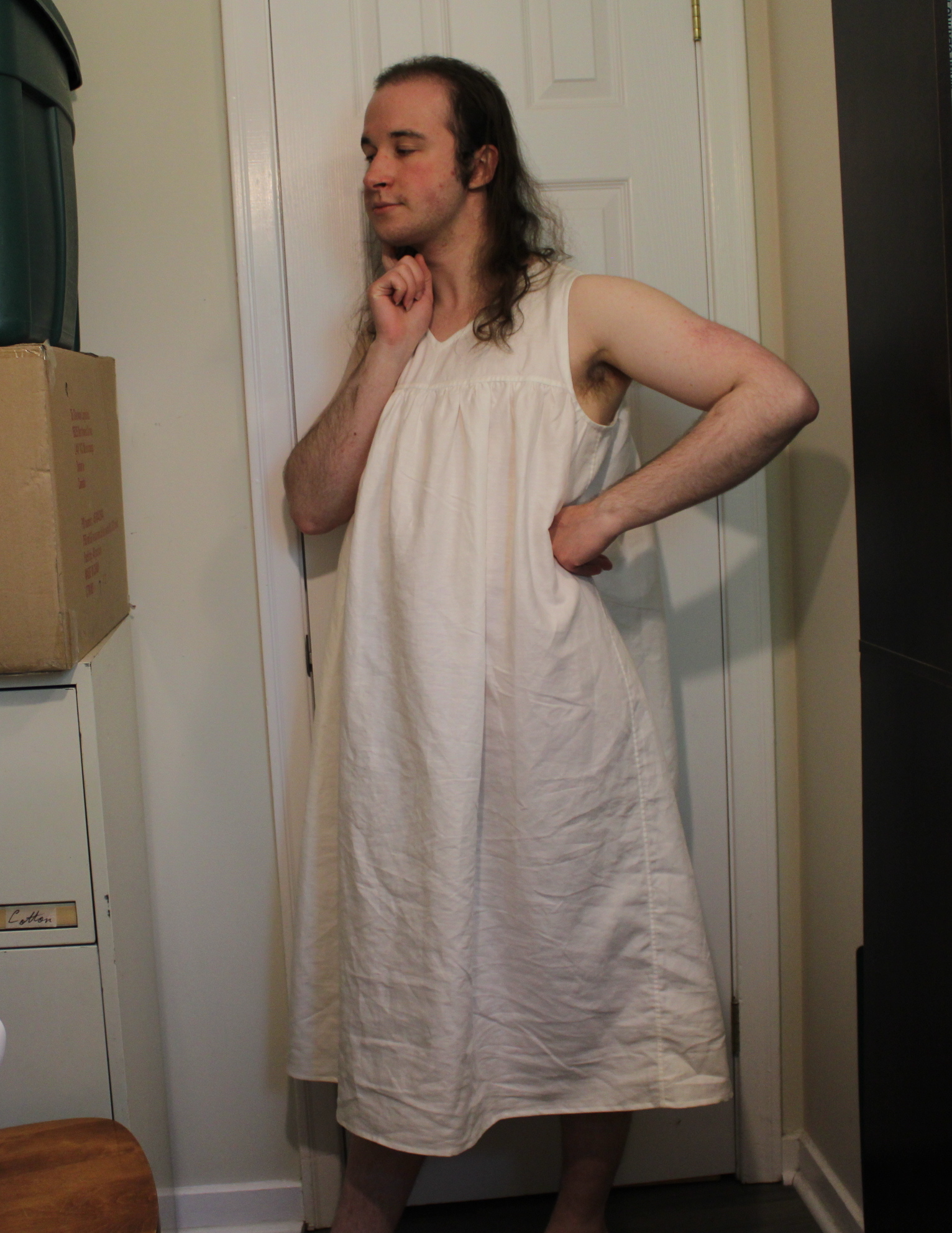
I made a few changes to it after the first time I sewed it up, and here is my final pattern. Two small bodice pieces, cut on the fold, and the skirts are made of one big rectangle about 1m x 2m. (Or two one metre squares if you want)
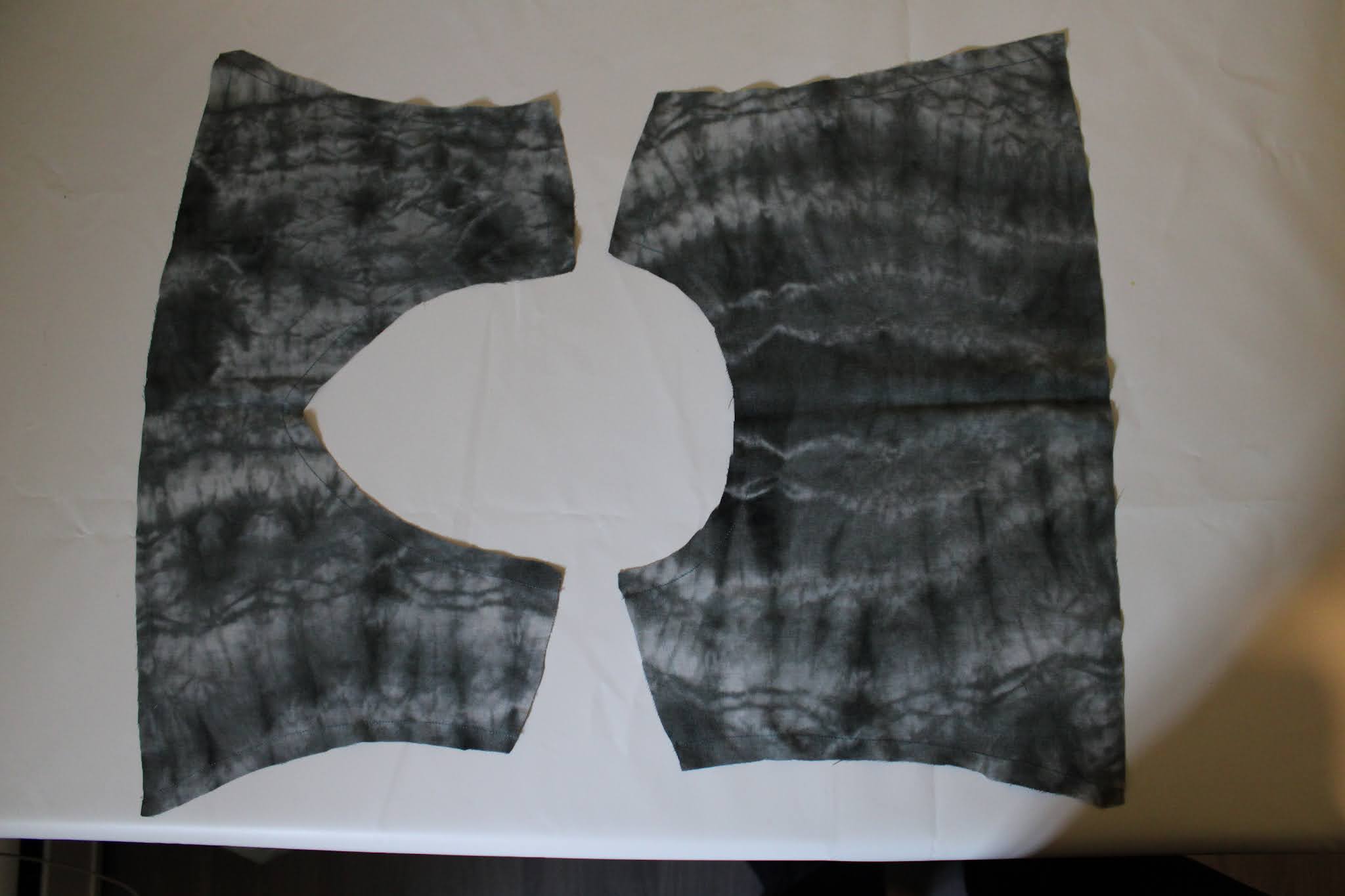
The crescent shape at the bottom is how much I cut out of the sides of the skirt pieces where the armpit is. The original had a small button placket in front, but I didn't think that was necessary so I just lowered the neckline enough to make it fit over my head.

My final pattern.

I sewed up the first one in a white linen which I got on sale from Fabricville years ago. (It's a twill weave, so not really suitable for 18th century shirts.) I did two squares for the skirt, but then realized that was unnecessary and did rectangles with one centre back seam for the next two. I used the thread pulling method to cut the skirt pieces out.

I sewed the side seams and basted the seam allowances down, then machine felled them.
I sewed and felled the shoulder seams and tried the bodice on over my head. It wasn't quite right, so I cut the neckline down a bit. I finished the neck hole with bias binding on the inside.

I gathered the skirt pieces to the bodice, leaving a little smooth space by each armpit where I'd cut out the little crescent shape.
For the first one I cut out an 18 cm long space in the underarm, but this proved to be too big, so I did 14 cm on the next two.
I finished the armhole with bias binding, and tried to fix the too-big armhole by doing some little pleats in there.
I sewed a narrow hem by machine.

I also put a small dart in the front before binding the neck, but that was just because my pattern wasn't quite right and I needed to take a bit of fullness out of there.
It's quite comfortable, and good in hot weather.


For my second one I used a soft grey rayon, which I got on clearance from fabricville many years ago. I took more progress pictures of this one.
Since the rayon is so shifty I staystitched all the curved edges first. 
It's a bit hard to see, but there's staystitching here.

The bias binding I made for the neck and arm holes.

Bodice with shoulder seams and neck hole finished.
To finish off the seams where I gathered the skirt to the bodice I cut two long rectangles on the straight grain and sandwiched the gathered skirt edge in between them and the bodice.
Gathers pinned and sewn to bodice.

Long rectangle pinned to gathered edge.
And I pressed it up, turned it under, and machine sewed it down.
I hand basted it first, because it's such a slinky material.
I then cut out the crescent shapes from the sides and staystitched that, though I realized later it would be more practical to do it before sewing the bodice on.
I sewed bias binding around the armholes, pressed and folded it in, basted it in place and machine sewed around the edge, same as the neck hole.
This one is the most comfortable of the 3. I'm sure the linen one will get softer with repeated washings, but I will definitely make more rayon ones.

The third one is the least comfortable, being made from a very cheap clearance cotton that has a simple eyelet pattern along one edge
The embroidery is not really scratchy, but it is kind of bumpy.
Making bias binding.
It's also the exact right height to perfectly snag on the wing nuts on my embroidery frame every time I walk past it, which is quite often since my room is so cramped. Had I know this I would not have bought this fabric!
I went around all the little squares while felling this bit.
I tracked my hours for the last one and it took a bit less than 6 hours, but someone faster could probably do it in much less time.